
O que você está procurando?

QuandoInstalação de painéis solares em um terreno planoPara telhados com pouca inclinação, o método de montagem é um dos primeiros aspectos a serem considerados. Duas opções são comumente utilizadas:sistemas de montagem solar lastreadosesistemas de montagem de telhado penetrantesNenhuma das duas opções é a escolha certa para todos os projetos. A construção do telhado, a capacidade estrutural, as condições de vento, a impermeabilização e os requisitos de instalação precisam ser considerados antes de tomar uma decisão.
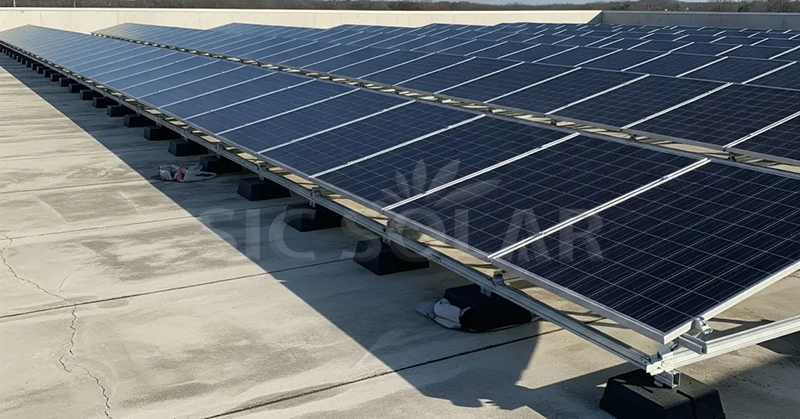
UMsistema de montagem lastreadoA fixação dos painéis solares é feita com lastro, geralmente blocos de concreto ou outros pesos aprovados, em vez de fixá-los diretamente na membrana do telhado. Uma de suas maiores vantagens é evitar ou reduzir significativamente as perfurações no telhado. Isso pode ser útil em telhados onde a manutenção do sistema de impermeabilização existente é uma prioridade.
Os sistemas com lastro também podem tornar o processo de instalação relativamente simples. Os componentes de montagem podem ser dispostos em torno de elementos existentes no telhado, como drenos e caminhos de acesso, sem a necessidade de criar muitos novos pontos de fixação. No entanto, o peso do lastro não pode ser negligenciado. A estrutura do telhado precisa ser verificada para garantir que suporte com segurança os painéis, o sistema de montagem e o lastro adicional.
UMsistema de montagem de telhado penetranteAdota uma abordagem diferente. A estrutura de montagem é fixada mecanicamente ao telhado ou, quando apropriado, diretamente aos elementos estruturais abaixo do material de cobertura. Quando projetado corretamente, esse tipo de sistema pode proporcionar uma conexão robusta e uma resistência eficaz à ação do vento sem a necessidade de adicionar grandes quantidades de lastro ao telhado.
A desvantagem é que as penetrações no telhado exigem atenção cuidadosa. Cada penetração deve ser devidamente selada e integrada ao sistema de cobertura existente. O rufo, os materiais impermeabilizantes e os detalhes da instalação desempenham um papel importante na prevenção de vazamentos futuros. Por esse motivo, a instalação deve ser coordenada com os requisitos do sistema de cobertura específico.
Condições de ventosão outro fator importante. Um sistema lastreado depende do seu peso, disposição e design aerodinâmico para resistir ao movimento, enquanto um sistema penetrante transfere as cargas através de conexões mecânicas à estrutura do edifício. As condições de vento locais e a exposição do telhado devem, portanto, ser consideradas no projeto de montagem, em vez de serem tratadas como uma reflexão tardia.
Em alguns projetos, a decisão também pode depender do estado e da vida útil esperada da cobertura. Uma solução com lastro pode ser interessante quando é necessário minimizar as perfurações na cobertura, enquanto um sistema com perfuração pode ser mais adequado quando a fixação estrutural está prontamente disponível e manter o peso da cobertura baixo é importante.
SIC SolarFornecemos sistemas de montagem fotovoltaica para diferentes aplicações em telhados planos. A configuração de montagem adequada pode ser selecionada de acordo com a estrutura do telhado, a localização do projeto, as condições de vento e neve, o layout dos painéis e os requisitos de instalação.
P: Qual é mais econômico, um sistema de montagem com lastro ou um sistema de montagem penetrante?
R: Não há uma resposta definitiva. O custo total depende da estrutura do telhado, do lastro necessário, dos componentes de montagem, da mão de obra, do tamanho do projeto e das condições de instalação. Um orçamento específico para o projeto oferece uma comparação mais precisa.
P: Um sistema de montagem solar com lastro requer perfuração no telhado?
A: Na maioria dos casos, os sistemas lastreados são projetados para evitar a penetração mecânica na membrana do telhado. O projeto exato depende da configuração do telhado e do sistema.
P: Um sistema lastreado pode ser usado em áreas com ventos fortes?
R: Sim, desde que o sistema seja projetado adequadamente para as condições locais. O peso do lastro, a disposição dos painéis, os defletores de vento, a altura do telhado e a exposição do local podem afetar o projeto.
P: Que informações são necessárias para uma solicitação de cotação (RFQ)?
A: Informações úteis incluem o tipo e as dimensões do telhado, a localização do projeto, as especificações dos painéis, a capacidade do sistema, a capacidade de carga do telhado, as cargas locais de vento e neve e o método de montagem preferido.
P: É possível instalar um sistema de penetração em um telhado impermeabilizado?
A: Sim. No entanto, todas as aberturas no telhado precisam ser devidamente detalhadas, impermeabilizadas e seladas de acordo com as especificações do fabricante da cobertura.
P: Como sei qual sistema de montagem é o mais adequado para o meu telhado?
A: Comece pela construção do telhado, capacidade estrutural, requisitos de impermeabilização, cargas ambientais locais e condições de instalação. Esses fatores ajudarão a determinar se o lastro, a fixação mecânica ou outra abordagem de montagem é mais adequada.
P: A SIC Solar pode ajudar na seleção de uma solução de montagem?
R: Sim. O sistema de montagem pode ser adaptado à estrutura do telhado, às especificações dos painéis, às condições ambientais e aos requisitos do projeto para desenvolver uma configuração adequada.



 IPv6 Rede suportada
 português
  English
 Deutsch
 español
 Nederlands
 العربية
 日本語
日本語 한국의
한국의 Melayu
 Tiếng việt